Our Products
Compressed Air Solutions
  • Screw Air Compressor
  • Oil Free Compressor
  • Diesel Portable Compressor
  • Gas Compressor
  • Specialty Compressor
  • Air Treatment
ISO 9001 Certified
24-Month Warranty
OEM & ODM Support
Factory Direct Price
All products→
How Altitude and Elevation Affect Air Compressor Performance
Technical Guide

How Altitude and Elevation Affect Air Compressor Performance

Technical Article
18 min read
Altitude

Atmospheric pressure at sea level is 14.7 psi. At 10,000 feet, 10.1 psi. Compressor displacement does not change with altitude. The air filling that displacement does. 26% fewer molecules at 10,000 feet. Nameplate CFM is volume flow. End-use equipment consumes mass flow. At altitude these diverge.

14.7 psi
Pressure at sea level
10.1 psi
Pressure at 10,000 ft
26%
Fewer air molecules

Compression Ratio

Take a compressor delivering 100 psig at sea level. Discharge absolute is 100 + 14.7 = 114.7 psia. Intake is atmospheric, 14.7 psia. Compression ratio 114.7 / 14.7 = 7.8:1.

Same compressor at 10,000 feet. The gauge still reads 100 psig because the downstream equipment still needs 100 psig. Discharge absolute is 100 + 10.1 = 110.1 psia. Intake is 10.1 psia. Compression ratio 110.1 / 10.1 = 10.9:1.

7.8:1Ratio at sea level
10.9:1Ratio at 10,000 ft

Work the discharge temperature. Assume intake air at 80°F, which is 540°R. At sea level:

T2 = 540 × (114.7/14.7)^((1.4-1)/1.4)
T2 = 540 × (7.8)^(0.286)
T2 = 540 × 1.935
T2 = 1045°R = 585°F

That is the theoretical adiabatic temperature with no cooling, no losses. Single-stage recips have internal cooling from cylinder walls and oil mist and the volumetric inefficiency dumps some of the heat into recompression of clearance gas rather than driving up discharge temperature linearly. Field discharge temperatures on single-stage recips at sea level land around 280°F to 300°F, depending on the clearance ratio, the RPM, whether the cylinders are finned or jacketed, the ambient, the valve condition. The gap between the theoretical 585°F and the field 290°F is the sum of all those cooling effects.

At 10,000 feet:

T2 = 540 × (110.1/10.1)^(0.286)
T2 = 540 × (10.9)^(0.286)
T2 = 540 × 2.16
T2 = 1166°R = 706°F

Theoretical discharge just went from 585°F to 706°F. The cooling mechanisms that brought 585°F down to 290°F in the field do not scale proportionally. They have roughly the same absolute cooling capacity (same cylinder surface area, same oil injection rate, same airflow over the fins). The additional 121°F of theoretical temperature does not get fully absorbed. What was 290°F at sea level becomes 380°F or more at altitude. The high-temp shutdown on most single-stage units sits between 325°F and 350°F.

The machine trips. Runs a few minutes, trips, cools down, restarts, trips. If ambient is warm, it may reach the shutdown temp before it even finishes loading because the sump carries residual heat from the previous cycle.

What happens next on the service side: the tech reads a high-temp fault code. Checks the oil cooler for blockage. Checks the thermal valve. Checks the fan. Everything is normal. If the tech has altitude experience, the call wraps up with "wrong compressor for this elevation." If not, parts start getting swapped. Thermostat. Oil. Sometimes the unloader valve, because the symptom looks like an unloading problem to someone who has never seen altitude do this.

Two-stage recips put an intercooler between two lower-ratio stages and each stage stays within its thermal envelope. Below 5,000 feet, two-stage is an efficiency upgrade. Above 8,000 feet it determines whether the machine can stay loaded.

Oil takes a beating from the temperature. The Arrhenius approximation gives a doubling of oxidation rate per 18°F. The actual multiplier varies by oil product. 80°F of additional thermal load between sea level and 10,000 feet is enough to cut oil life from 4,000 hours to somewhere under 1,500 hours, and that is on the oils that handle heat well. A cheap mineral oil that was marginal at sea level will coke up in months at altitude. Carbon deposits foul valve plates, intake valves start sticking, discharge valves start leaking, and valve service intervals go from annual to every four or five months.

The procurement problem with all of this: the person writing the equipment spec for a high-altitude site copies the CFM and pressure numbers from a previous project. The compression ratio is not on the spec sheet. Whether the distributor catches the altitude depends on where the distributor is located and how many high-altitude jobs they have seen. The machine arrives, gets installed, and the symptoms start within the first week.

Screw Compressor Volume Ratio

Screw compressors have a built-in volume ratio, Vi, set by the rotor profile and the discharge port position. It is machined into the housing at manufacture. It does not change.

Vi on the Atlas Copco GA 30 through GA 90 range runs 3.5 to 4.5 (GA 30+-90 instruction book, P/N 2920 7066 02, airend specs section). Kaeser publishes comparable data in the BSD/CSD service manual. Ingersoll Rand R-series documentation is vaguer about Vi than the European OEMs.

When Vi matches operating conditions, the chamber pressure equals line pressure when the discharge port opens. At 10,000 feet the required ratio exceeds the Vi design range. The port opens while chamber pressure is still low. Air from the discharge piping rushes backward into the chamber. Under-compression.

Energy penalty: 0.3% to 0.5% specific power degradation per 1% of under-compression. Where those numbers come from: they are interpolated from published PV diagram analyses on twin-screw compressors. The coefficient depends on rotor profile. The Sigma profile that Kaeser uses, the asymmetric profiles Atlas Copco and IR use, they all give slightly different coefficients because the discharge port timing and the volume-pressure relationship during the compression stroke are geometry-dependent. At altitude, under-compression can reach 15% to 20%.

The bearing damage is worth spending some time on. Each backflow event when the discharge port opens is a pressure reversal that loads the rotors axially and radially in a pulse. Four-lobe male rotor at 3,600 rpm is 14,400 pulses per minute. These are small individually. They accumulate. In the L10 life equation:

L10 = (C/P)^p × 10^6 / (60 × n)

where C is the basic dynamic load rating, P is the dynamic equivalent load, p is the exponent (3 for ball bearings, 10/3 for rollers), and n is RPM. The pulse loading enters through P. Under steady load, P is straightforward. Under pulsating load, P increases because the peak loads during pulses contribute disproportionately (the life equation has that exponent, so peaks hurt more than the arithmetic average would suggest). SKF documents correction methods for this in the Rolling Bearings catalog (PUB BU/P1 10000/2 EN), variable loading section. The corrected L10 under chronic under-compression conditions works out to 60% to 70% of catalog life.

Applying this in the field requires knowing the pulse magnitude, which requires pressure transducers in the discharge cavity sampled at high frequency. This is not standard instrumentation.

VSD machines (Atlas Copco VSD+, Kaeser SFC) handle altitude better because they adjust speed to keep the operating ratio closer to the Vi design point. Above 8,000 feet the VSD premium pays back in two to three years.

Derating Tables

Acceptance test at sea level per ISO 1217 Annex C (current edition ISO 1217:2009). Data goes into the ISA standard atmosphere model (ICAO Doc 7488/3) to get intake density at the target altitude. A volumetric efficiency correction factor is applied. Out comes the derated FAD.

No testing at altitude. The cost of Annex C compliance at 10,000 feet is prohibitive. Calibration-standard air sources at altitude conditions for flow measurement nozzles alone would be a major investment.

The correction factor is the problem.

Recips: clearance volume re-expansion is nonlinear with intake pressure. At top dead center, a pocket of compressed air is trapped. It has to expand below intake pressure before the intake valve opens. Lower intake pressure means more of the piston stroke is consumed by re-expansion and less is available for fresh charge. Plot volumetric efficiency against intake pressure and the curve steepens below about 10 psia. Above 12,000 feet (intake pressure around 8.9 psia) the nonlinearity gets pronounced, pushing actual volumetric efficiency four to six points below what you get from linear extrapolation.

Screws: leakback through rotor clearances increases at altitude because the differential across the gaps is higher (same discharge, lower intake). Gap dimensions are not constant; they grow with operating hours as coatings wear. Oil film sealing effectiveness at the gap varies with oil condition and temperature. Speed matters. A proper model requires CFD and is not part of the standard derating process.

The CAGI Data Sheet format requires stating test conditions. It does not mandate a conversion methodology. ISO 1217 Annex C prescribes test procedures in detail and is loose about altitude conversion. So two manufacturers citing the same standard can produce different derating numbers with different conservatism. Below 5,000 feet the differences are invisible. At 10,000 feet the gap between brands for equivalent machines can be wide enough to change a selection decision.

Above 10,000 feet, pad the derated values by 10% to 15%.

Oil Film and Oil Separation

The oil mist quality inside a screw compressor's compression chamber depends on air density. Lower density at altitude means less aerodynamic shearing force on oil droplets. The mist is coarser. The oil film on rotor surfaces is less uniform. Thin spots appear. Rotor profile accuracy degrades slowly over thousands of hours as metal contact occurs at thin spots. Clearances open. Leakage increases. Capacity drops.

Vibration monitoring does not catch this while it is developing. Oil analysis does not catch it. Both stay in normal bands. Maintenance records look clean for a year, two years. Then a capacity test shows 15% deviation from baseline and the airend needs a rebuild.

The coalescing element in the oil separator has a design velocity window. At altitude the velocity profile shifts. Separation efficiency drops. A machine rated for 1 to 3 ppm residual oil at sea level can pass 5 ppm or more at 10,000 feet. The extra oil reaches the refrigerated dryer, coats the evaporator surfaces, degrades heat transfer, and the outlet dew point drifts upward. Fractions of a degree per day. Not detectable against normal reading noise. Over months it accumulates to several degrees. Fin fouling, refrigerant charge variation, and ambient temperature swings all affect dew point at the same time, so attributing the drift to oil carryover specifically is not possible with field instruments.

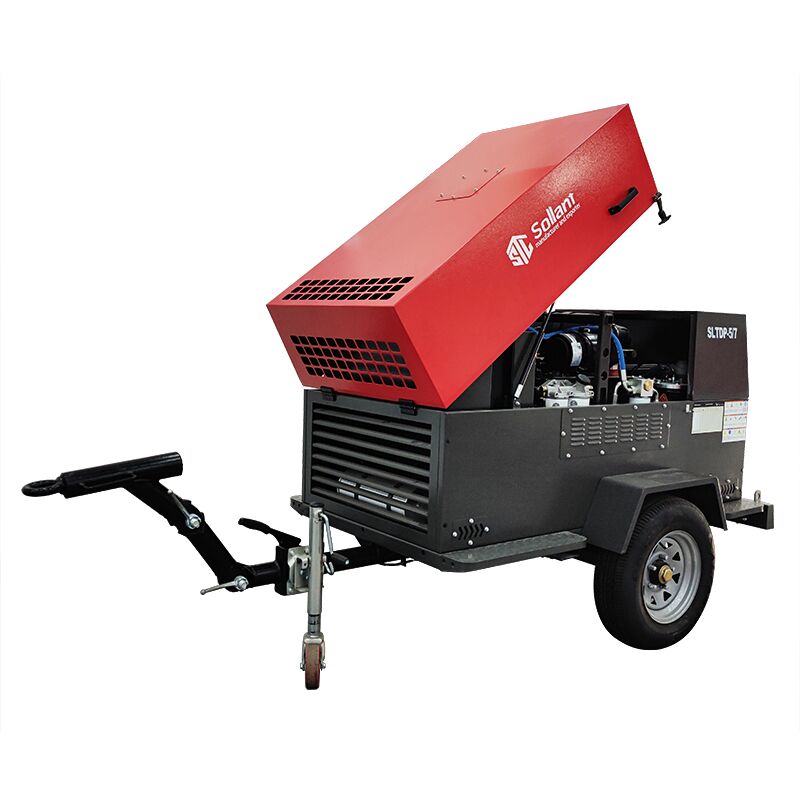
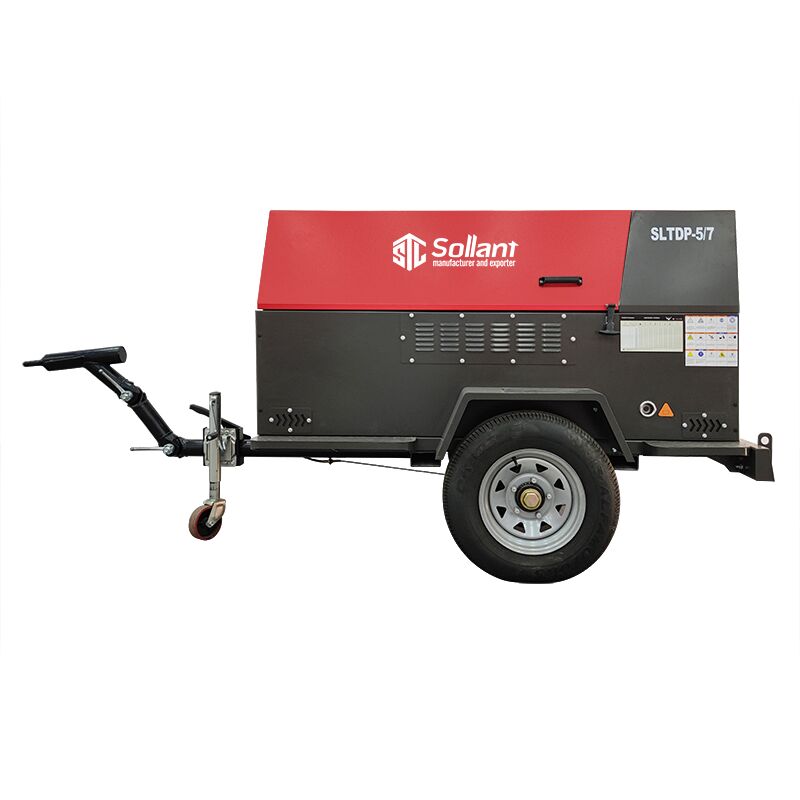
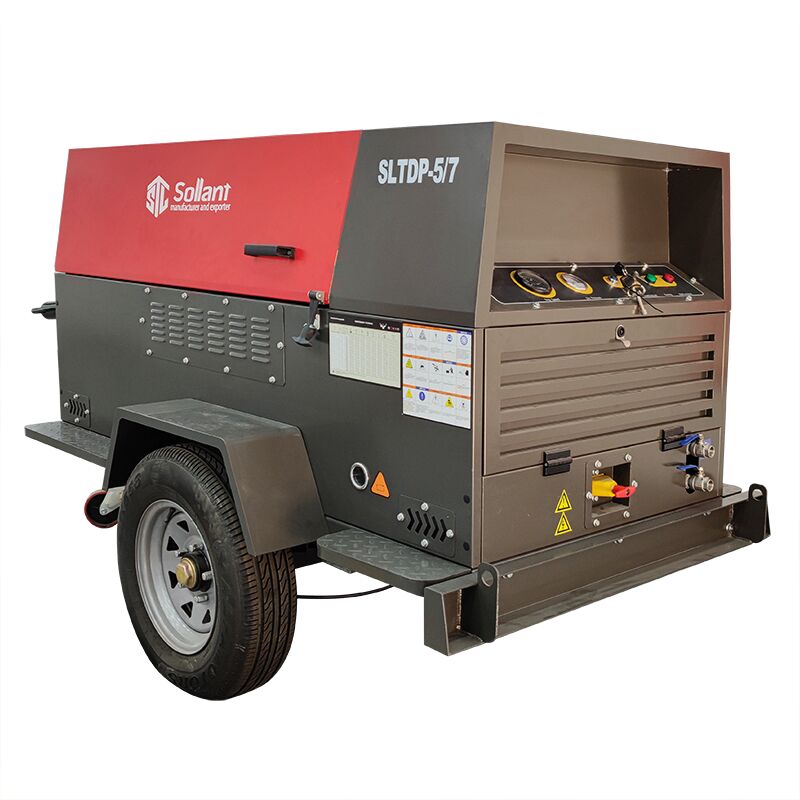
Engine-Driven Portables

Diesel towable compressors get hit on both sides at altitude. Engine: naturally aspirated diesels lose 3% of rated power per thousand feet. Turbocharged engines recover most of that on the engine side. Compressor: intake air density is down regardless of turbocharging, because the engine and the compressor breathe through separate intakes. The losses stack.

Rental fleet portables get towed between elevations constantly. Pressure transducers read gauge. Load/unload setpoints are in gauge. A unit configured at 3,000 feet goes to 9,000 feet with the same settings. The same gauge setpoint now corresponds to a different absolute pressure. VSD frequency windows are affected too. Recalibration after every move is the correct practice. On rental fleets this is skipped.

Failure Clustering

Below 6,000 feet, parameters stay inside design margins. Above 8,000 feet, failures cluster in a narrow time window.

Multiple subsystems each have tolerance limits. Discharge temperature. Oil condition. Seal integrity. Leakback rate. Each absorbs altitude stress independently while inside its own boundary. When discharge temperature enters the accelerated oil oxidation zone, the thermal load propagates. Degraded oil seals worse at the clearances. Worse sealing increases leakback. More leakback raises discharge temperature. The feedback loop closes and converges toward shutdown. From first high-temp alarm to continuous trips can be two weeks.

8,000 feet is empirical. Generous margins push the threshold to 9,000 or 10,000. Tight margins can trigger the cascade at 6,500.

Barometric Pressure Fluctuation

Standard atmosphere model assigns fixed pressure to each altitude. Weather moves the local barometric reading by 15 to 25 mbar. At sea level, 25 mbar against 1013 is 2.5%. At 15,000 feet, where standard pressure is 572 mbar, 25 mbar is 4.4%. A compressor at altitude near its thermal limit trips during the low-pressure passage. Altitude unchanged. Load unchanged.

Put a recording barometer at the site. Compare alarm timestamps with the barometric trace.

Sizing

Downstream demand: pressure and flow rate the tools require. Multiply the flow rate by 14.7 divided by local atmospheric pressure. At 10,000 feet: 1.455. A 150 CFM demand at the tools means a 218 CFM sea-level nameplate.

1.455Correction factor at 10,000 ft
150 → 218CFM demand vs. rated CFM

After that: confirm the machine holds discharge temperature at the altitude compression ratio. Recalculate piping pressure drop (larger compressor, more volume flow through the same pipes, velocity up, friction up, 3 psi at sea level becomes 5 to 6 psi). For engine-driven units, the prime mover derating needs its own pass.

Mobile units moving between elevations have the gauge-vs-absolute calibration problem described above.

Temperature

High altitude is usually cold. Cold air is denser. Partial offset of the barometric pressure loss.

High altitude with high ambient temperature is the worst case. Desert highlands. Equatorial dry season. Compressors inside unventilated enclosures where cooling air recirculates and effective ambient runs 15°F to 20°F above outdoor temperature.

Air-cooled aftercoolers and oil coolers lose capacity at altitude. Less dense cooling air carries less heat per unit volume. Aftercooler outlet temperatures rise. More moisture enters the dryer. For moisture-sensitive applications (spray painting, pneumatic instruments, food processing) the dryer inlet condition at altitude has to be part of the system design.

Absolute humidity at altitude tends to be low. Total condensate volume is small. Contaminant concentration per unit of condensate goes up because the same oil and particulate load is distributed across less water. Oil-water separator adsorbent media loads faster. Replacement intervals calibrated to sea-level condensate volumes may not be frequent enough.

Oil-free screw and centrifugal compressors behave differently at altitude. Centrifugal machines have surge margin shifts in thin air that vary with impeller design, and the variation across frame sizes is large enough that generalization is not useful. Receiver tank sizing at altitude is a volume recalculation using corrected flow. Actuator thrust changes when exhaust backpressure drops from 14.7 to 10.1 psia, which affects cylinder sizing for process valve actuators.

Footer Component - SOLLANT
滚动至顶部