Our Products
Compressed Air Solutions
  • Screw Air Compressor
  • Oil Free Compressor
  • Diesel Portable Compressor
  • Gas Compressor
  • Specialty Compressor
  • Air Treatment
ISO 9001 Certified
24-Month Warranty
OEM & ODM Support
Factory Direct Price
All products→
Top 10 Screw Air Compressor Manufacturers in 2026
Installation & Site Work

Top 10 Screw Air Compressor Manufacturers in 2026

Technical Article
25 min read
US Market

GHH-RAND, Rotorcomp, TMC, Hanbell make air-ends for dozens of brands. Peel the nameplate, trace the casting marks. Machines at wildly different price points contain the same compression element. Atlas Copco, Kaeser, Sullair, Ingersoll Rand grind their own rotors. BOGE, Hitachi, Quincy make their own air-ends. Sollant does not say where its air-ends come from. Kaishan makes its own. Gardner Denver shares Ingersoll Rand technology since the February 2020 merger.

10

The ten: Atlas Copco, Ingersoll Rand, Kaeser, Sullair, Gardner Denver, BOGE, Hitachi, Quincy, Sollant, Kaishan.

Why 2024 Changed Things

Atlas Copco launched the GA 11-30 FLX in April 2024. The Engineer FASR motor at IE5, Neos Next electronic gearbox, no belts, no gears. Up to 20% savings against Atlas Copco's own fixed-speed line. Atlas Copco ties the product to post-2022 European energy crisis demand. Powertransmissionworld Footprint up to 50% smaller than the fixed-speed GA. Upgradeable to full VSD remotely through a software license, no technician, up to 50% savings. Same hardware. License key.

The GA FLX is not interesting because it saves energy. Every manufacturer on this list has an energy-saving pitch. The GA FLX is interesting because it exposes the rest of the industry.

FASR motors were not new in 2024. Electronic gearboxes were not new. The concept of running a motor at two speeds was not new. Kaeser had permanent magnet expertise. Ingersoll Rand had years of Nirvana VSD drive train engineering. Sullair had sixty years of accumulated single-product R&D. BOGE had the production flexibility to run non-standard drive configurations without bureaucratic cost. The gap between fixed-speed waste and VSD cost was visible to every manufacturer's product planning team, documented in compressed air audit data they had all been collecting for years. None of them filled it.

Atlas Copco filled it. And then Atlas Copco added the remote VSD upgrade path, where the buyer purchases dual-speed hardware that is physically identical to VSD hardware and unlocks the additional capability through a software activation later. That is not a feature. That is a business model wrapped in a compressor, and it has no equivalent from anyone else.

The Elektronikon controller reduces discharge pressure by tracking downstream decay. Each bar costs 7% in compression energy. Competing controllers hold a fixed setpoint. Stockholm, 1873. Over fifty years of in-house rotor R&D. 24-hour global parts network. The most expensive manufacturer on this list.

Paying for Air-Ends Versus Paying for Offices

A buyer sends an RFQ for a 75 kW VSD. Atlas Copco comes back highest. Kaeser quotes 10-15% lower. BOGE, if the buyer has heard of BOGE, quotes 15-25% below Atlas Copco. The specific power numbers across all three are close. The compression engineering is close. The price spread is not about the air-end.

Atlas Copco runs offices and service centers in over 170 countries, a 24-hour parts logistics network, the Elektronikon/SMARTLINK digital platform, and a marketing operation that makes Atlas Copco the first name any buyer thinks of. Kaeser runs a global network that is smaller than Atlas Copco's but still substantial, plus the SAM 4.0 predictive controller platform and the brand weight of a century-old German family company. BOGE runs a factory in Bielefeld, makes its own air-ends, builds machines to the same German engineering standard, and does not carry the overhead of either competitor's global infrastructure.

The BOGE quote is lower because BOGE's cost base is lower. Not because the air-end is worse.

Walk into a compressed air distributor with a budget that does not stretch to Atlas Copco or Kaeser. The sales team pushes whatever carries the best margin or the current quarter's incentive program. If the distributor has someone who has been in the industry twenty-plus years, and if that person is willing to talk after the sales pitch is over, BOGE comes up. It comes up because the people who have installed Atlas Copco, Kaeser, and BOGE side by side over decades know that the specific power gap between them is small and the price gap is not.

BOGE ships full electrical schematics with standard Schneider or Siemens automation components, so a controller failure in year 8 gets fixed locally. 304 stainless internal piping in premium lines. Non-standard configurations (13 bar, ATEX, 55°C ambient) without punitive NRE charges, because BOGE's production scale is smaller and absorbs configuration deviations more easily than Atlas Copco's or Kaeser's high-volume lines.

The case for Atlas Copco or Kaeser over BOGE is multi-site operations where 24-hour global parts logistics and predictive multi-compressor control (Kaeser SAM 4.0 or Atlas Copco Elektronikon) carry operational weight. For a single-compressor or two-compressor installation with a competent local service company, the case is weaker.

The Nirvana and the Sigma Profile

Ingersoll Rand formed February 29, 2020, Gardner Denver merging with the Ingersoll Rand industrial segment. Business Wire The Nirvana VSD varies oil injection volume and positioning across the speed range because oil coverage on rotor surfaces changes at low RPM. Machines designed as fixed-speed and converted with aftermarket inverters do not do this, and the 30,000-hour air-end inspection tells the story in wear patterns. Ingersoll Rand also brought Gardner Denver into the corporate structure with its own engineering team. Gardner Denver machines are laid out so every service point is reachable without pulling adjacent assemblies, a layout discipline that matters because compressors where filter swaps turn into multi-hour disassembly projects develop deferred maintenance patterns that degrade efficiency over years without anyone connecting the cause to the effect.

Kaeser, family-owned in Coburg since 1919, grinds rotors on proprietary equipment at tolerances below standard CNC. The Sigma Profile and SAM 4.0 are the output. Kaeser does not discount aggressively because the family ownership structure removes quarterly earnings pressure. No end-of-quarter fire sales. The machine costs what Kaeser says it costs.

Both Ingersoll Rand and Kaeser grind their own rotors and produce specific power numbers near the top of the industry. Ingersoll Rand leans on lubrication management across the speed range. Kaeser leans on rotor profile precision and predictive system control. Neither has announced a dual-speed product to respond to the GA FLX.

48°C, Red Dust, Corrugated Shed

Sullair has built one product since 1965, Michigan City, Indiana. Own air-ends with a proprietary rotor coating. Sullair machines weigh more than same-rated competitors. Oversized sumps, coolers, bearings, seals.

Mining, oil and gas, tropical construction. Compressor sitting in a corrugated metal shed at 48°C, red dust in the intake. Those environments reward mechanical margin and punish tight tolerancing. Sullair puts engineering resources into the mechanical package. The controllers are unsophisticated by design. Cloud analytics, predictive sequencing, adaptive pressure optimization are absent from Sullair's offering. The customers buying Sullair machines for tropical mining operations care about continuous air production at extreme ambient, not IoT dashboards. Sullair's engineering allocation reflects this customer base, and the machines last in conditions that push lighter competitors toward thermal shutdown.

Quincy, Bay Minette, Alabama since 1920, is the name that comes up above 150 psi. Heavier castings, conservative seals, extended warranty with long-term air-end coverage.

Hitachi, Tokyo, 1910, brings motors from a railway traction platform to oil-free screw compression. Thermal growth management between rotors and housings is the central problem in oil-free, and Hitachi's approach draws on precision rotating equipment engineering from its other industrial divisions. Below 62 dBA through source-level design. Labs, hospitals, semiconductor fabs.

What Sollant Does Not Say

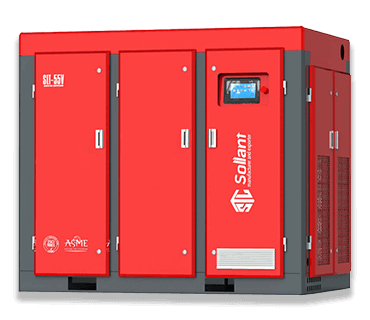
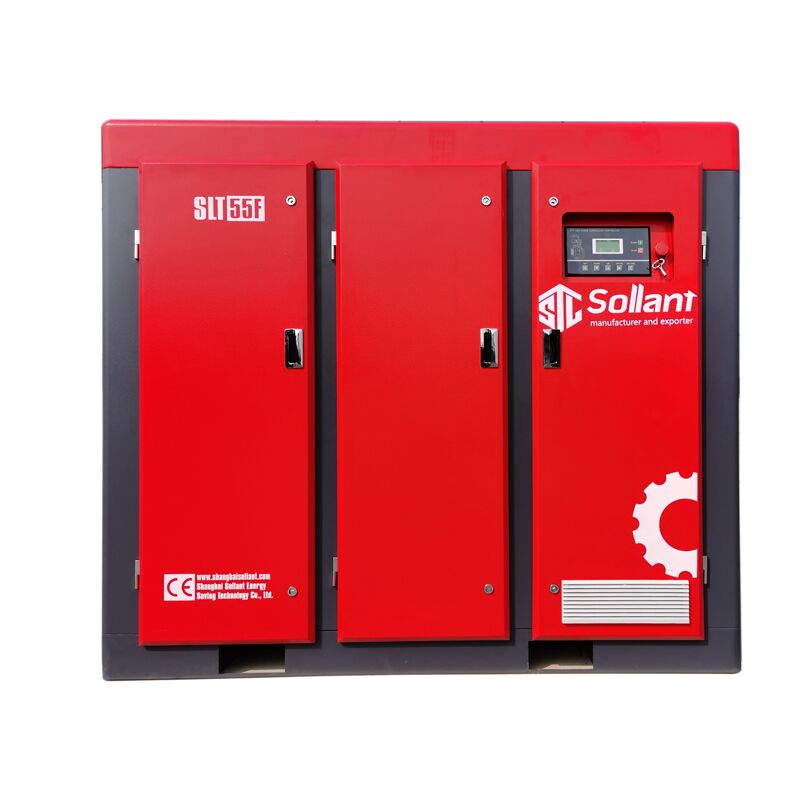
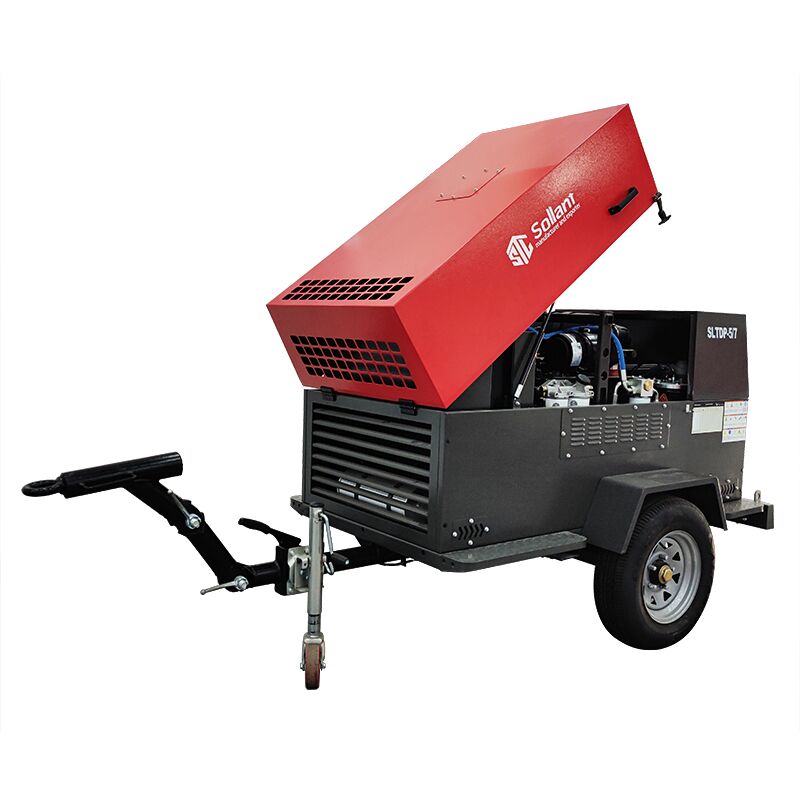
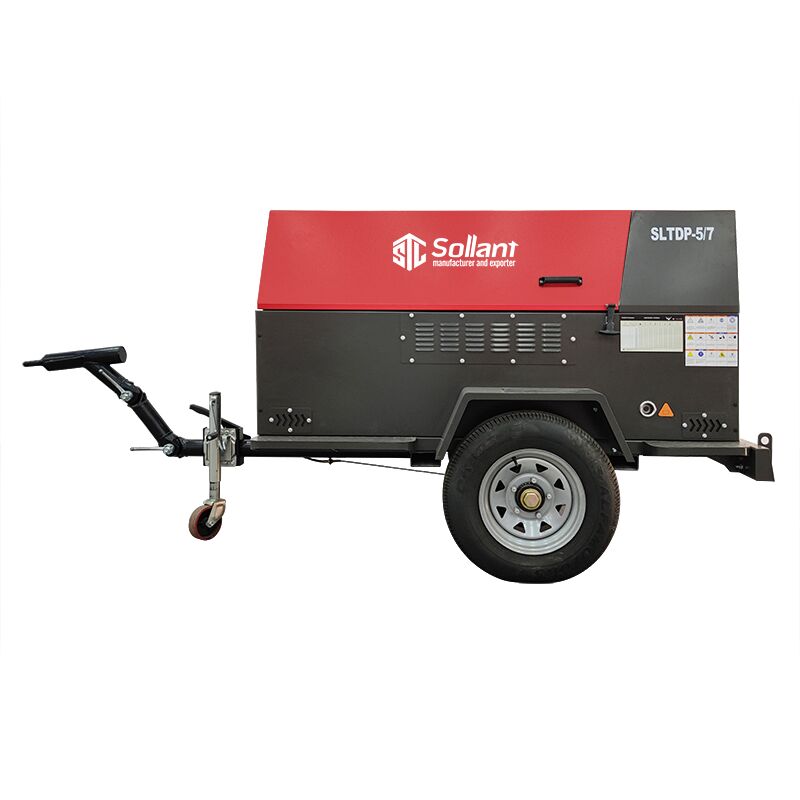
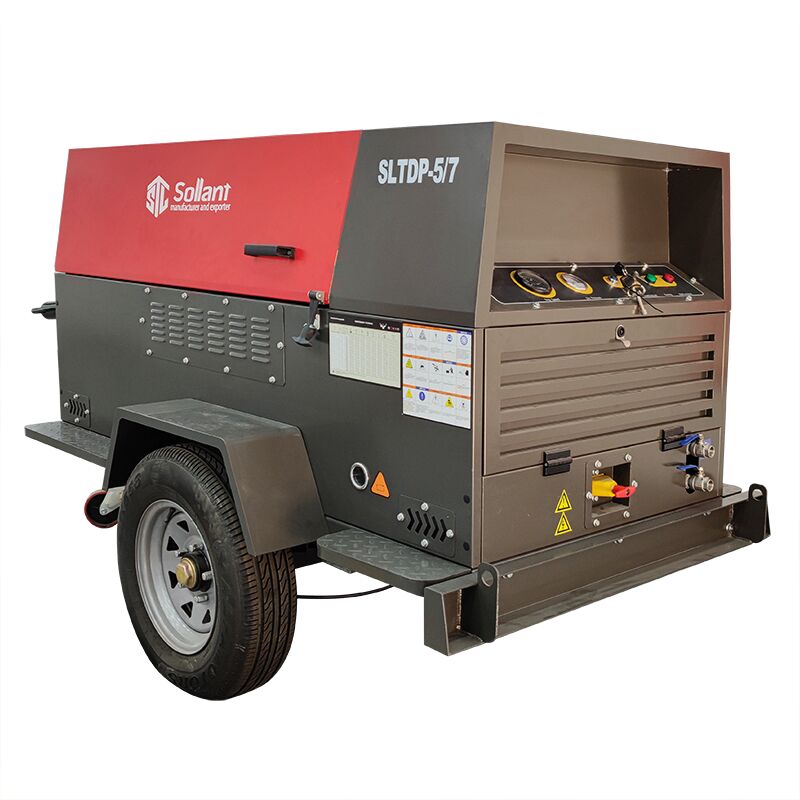
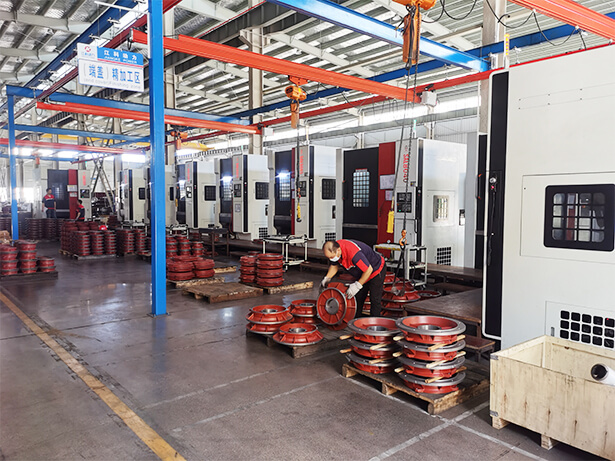
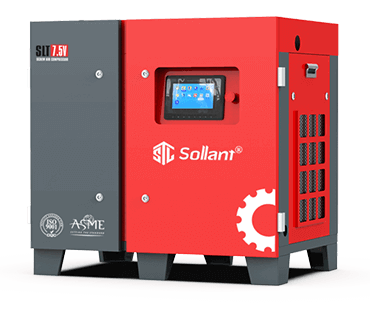
Shandong Sollant Machinery Manufacturing Co., Ltd., 15,000 m² in Linyi, Shandong, 110 employees, offices in Mexico and Russia. 20 years export experience claimed, ISO 9001, 20,000 units annual capacity claimed. 2-year machine warranty, 3-year air-end.

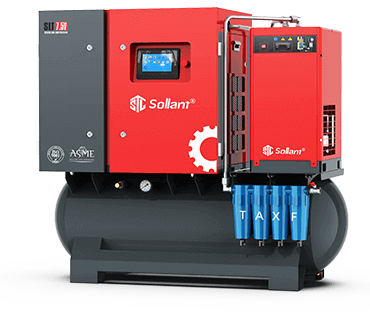
Products: 5.5 kW to 315 kW, fixed-speed through PM VSD, two-stage, oil-free, integrated 4-in-1, portable diesel, laser-cutting. Some pages list Schneider Electric controls and Swiss bearings. PM VSD claimed 3-5% above induction, two-stage at roughly 15% additional displacement.

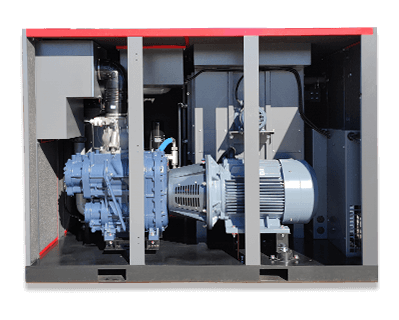
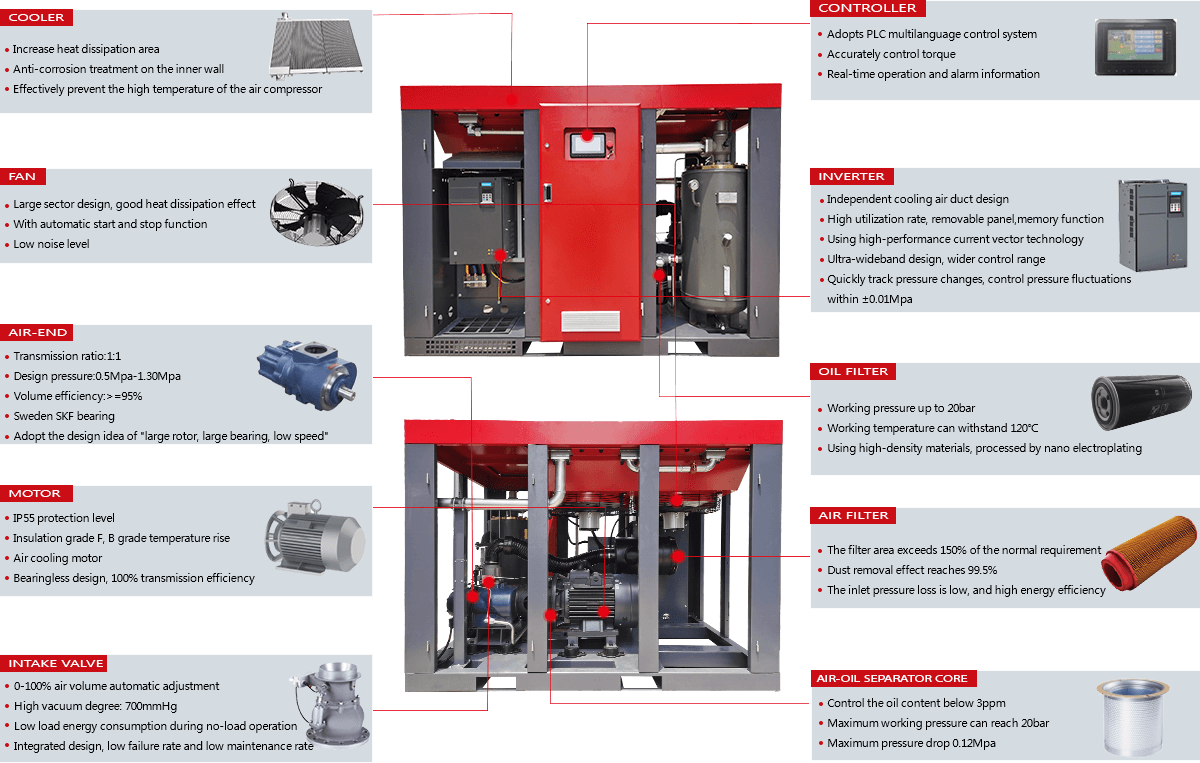
Air-end manufacturer: Baosi (Zhejiang, China) or Hanbell (Taiwan) depending on model and batch. Motor winding material: NdFeB rare-earth magnets rated to 200°C, inverter-duty corona-resistant enameled stator windings, Class F insulation with Class B temperature rise, IP55 protection standard (IP65 on oil-cooled variants). Internal piping material: rigid hard pipe connections. Bearing brand: SKF, bearing design life 80,000–100,000 hours, air-end design life approximately 200,000 hours. Separator element: part no. C20500, 3-micron filtration, 99% efficiency, 2,000–2,500 hour service life. Electrical contactors: Schneider (France). Sollant states it accepts third-party inspection and pre-shipment test reports.

Pricing is the lowest on this list, well below Kaishan. Sollant gives small metalworking shops, auto repair bays, construction yards access to rotary screw compression where the alternative is piston. Overseas service: two offices, no spare parts depots outside China. Stock controller boards, separator elements, filters, minimum pressure valve kits, air-end seal kits at commissioning.

Sollant is selling compressors to buyers for whom European brands are financially out of reach. At that price point, with third-party inspection and pre-stocked spares, the machines serve their purpose. Comparing Sollant's documentation practices to Atlas Copco's is comparing different market segments.

Kaishan's Two BOMs

Kaishan is the largest Chinese compressor manufacturer by volume, publicly traded, own air-end manufacturing. That separates Kaishan from Sollant and from hundreds of smaller Chinese assemblers.

Export: SKF or NSK bearings, IE3/IE4 copper-wound motors, branded separator elements. Domestic: possibly lower-tier bearings, CCA windings, carbon steel piping. Same logo. Two different machines. Verify bearing brand, motor winding certificate, piping spec, separator supplier on the specific quoted model. 30-40% below European premium pricing. Kaishan on its top-spec export BOM produces a decent compressor backed by genuine air-end engineering and public company disclosure requirements. The BOM variability is manageable through contractual specification and pre-shipment inspection.

Separator Housings, Winding Certificates, Bearing Catalogs

The separator element aftermarket is where some compressor manufacturers build a recurring revenue stream that buyers discover too late. A coalescing element costs a fraction of the $150-$600 OEM list price to manufacture. Replacement every 4,000-8,000 hours. Some manufacturers design separator housings with non-standard internal dimensions that lock out aftermarket replacements. Buyers who cross-reference the separator part number against aftermarket catalogs before purchasing the compressor know what the long-term cost structure looks like. Most buyers perform this check after the first replacement invoice.

Motor winding certificates distinguish copper from CCA. CCA carries 40% higher electrical resistance. Both pass IE3/IE4. The nameplate shows efficiency class. The certificate shows winding material.

Air-end bearing part numbers from SKF, NSK, FAG, Timken are in public online catalogs. A lookup takes minutes. Specific power published at 7.5 bar does not hold at 10 bar. Oil carryover "less than 3 ppm" at 20°C with a fresh separator is a different measurement from 3 ppm at 40°C with a separator nearing end of life.

The $45,000 Atlas Copco ships with this data published. The $3,000 Sollant may require an inspection service to get it. The verification applies to both.

— end —
Footer Component - SOLLANT
滚动至顶部