Our Products
Compressed Air Solutions
  • Screw Air Compressor
  • Oil Free Compressor
  • Diesel Portable Compressor
  • Gas Compressor
  • Specialty Compressor
  • Air Treatment
ISO 9001 Certified
24-Month Warranty
OEM & ODM Support
Factory Direct Price
All products→
What Is a Screw Air Compressor?
Technical Guide

What Is a Screw Air Compressor?

Technical Article
15 min read
Screw Compressor

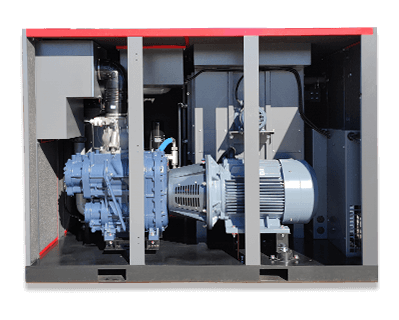
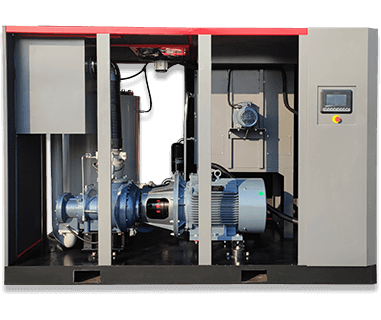
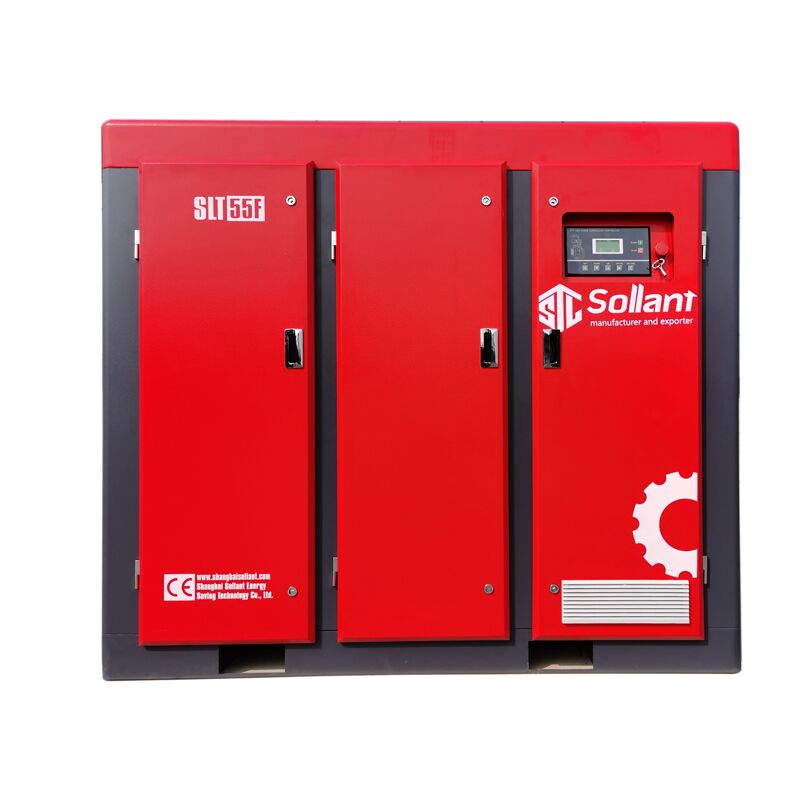
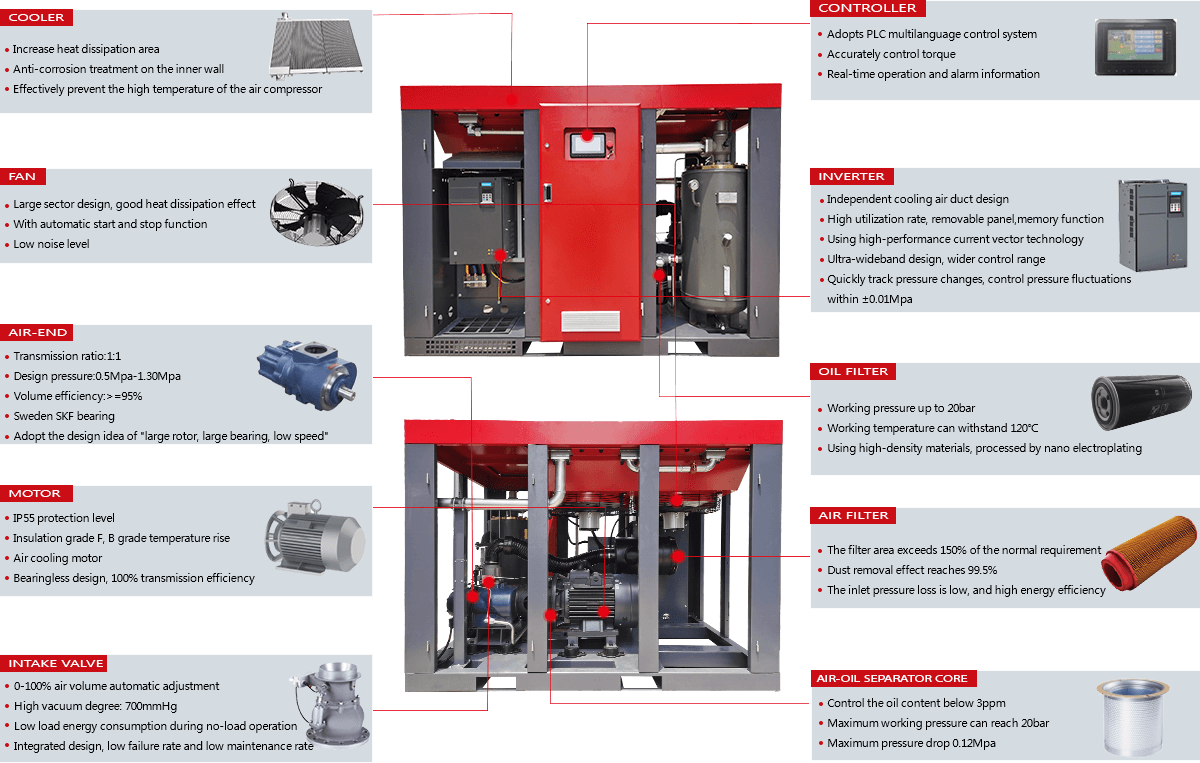
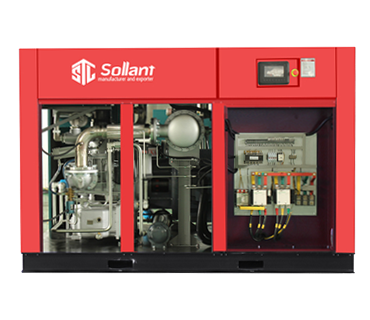
Airend, motor, oil separator tank, cooler, controller, pipes, valves.

Male rotor, four lobes. Female, six. Motor spins the male, female meshes. Air trapped between lobes, compressed, discharged. Oil-injected models put oil in the chamber for sealing, cooling, and lubrication. Air comes out with oil mist, gets separated. Rotors are ductile iron, QT500-7 or QT600-3, coated PTFE or moly disulfide.

Rotor profiles. SRM, GHH, Atlas Copco A-type copies. A percent or two between them.

Clearance.

The compressor industry treats clearance like a footnote. One line in the spec table, if it shows up at all. Sales presentations run forty slides on smart controllers, IoT connectivity, powder coat color options, the font on the touchscreen. Clearance gets nothing. And clearance is the reason one 37 kW machine costs 35,000 RMB and another costs 75,000 RMB and the expensive one pays for itself in four years and the cheap one doesn't.

Domestic airends, 0.05 to 0.08 mm. European, 0.03 to 0.05 mm.

Every revolution at 3,000 RPM, compressed air bleeds backward through the gaps. Air that already absorbed compression energy. Leaked back. Compressed again. Leaks back again. Motor draws the same current regardless.

The question that follows is obvious. Why not set the gap tighter. And the answer is the most interesting thing about screw compressors, more interesting than anything about profiles or oil separation or VSD or any of the stuff that fills up compressor marketing materials, and it has nothing to do with compressor engineering. It has to do with foundry metallurgy.

The male rotor, the female rotor, and the bore housing are three cast iron masses with different geometries, different thermal contact with the oil, and different rates of heat generation during operation. They expand at different rates. A clearance measured at room temperature on the assembly bench is a different clearance after forty minutes at full load. The thermal expansion coefficient of ductile iron is nominally 11 to 12 micrometers per meter per degree Celsius. Nominally. That number moves with the specific metallurgical state of each casting. And the metallurgical state depends on everything that happened in the foundry.

Carbon content. Silicon content. The magnesium treatment during spheroidization, where the timing of the magnesium alloy addition to the ladle, the temperature of the iron when it receives the treatment, and the recovery rate of magnesium in the melt all influence the graphite nodule morphology in the solidified casting. The inoculation practice, meaning the addition of ferrosilicon-based inoculant to promote graphite nucleation, where the amount, the timing relative to pouring, and the specific inoculant grade affect nodule count per square millimeter and size distribution. Pouring temperature. Fill rate into the mold. Sand mold moisture and binder content, which control cooling rate, which controls the pearlite-to-ferrite ratio in the matrix, which directly affects thermal expansion behavior, hardness, and dimensional stability at elevated temperature.

If the ladle temperature on the afternoon heat drifts three degrees from the morning heat because the furnace refractory is wearing and the melt shop operator compensates by adjusting power input timing, the castings from that heat can expand differently at operating temperature. If the sand moisture creeps up because the reclamation system is cycling slower in humid weather, the cooling rate shifts and the matrix microstructure changes. These are not hypothetical variations. These are the daily reality of every ductile iron foundry on earth. The question is how tightly a given foundry controls for them.

Atlas Copco's airend foundry supply chain has been under statistical process control for decades. Every heat gets a spectrographic analysis of the melt chemistry before pouring. Metallographic samples pulled from representative castings in each batch get image-analyzed for nodule count, nodule size distribution, nodularity percentage, and matrix phase ratio. The data feeds back to the melt shop. When a machining operator on the rotor line flags a blank that cuts differently, the deviation gets tracked through the serial number to the specific heat, the specific ladle record, the specific sand batch. The foundry process documentation at this level runs to hundreds of pages and represents decades of institutional knowledge about how specific process deviations propagate through to dimensional behavior in the finished part at operating temperature.

GHH has similar depth. VMC has similar depth. These are companies where the metallurgist and the machinist and the assembly technician are all looking at the same data and have been for twenty or thirty years.

Domestic airend producers have improved enormously and this deserves acknowledgment. Fifteen years ago, domestic clearances ran above 0.1 mm. Airends were loud, ran hot, and had service lives that made them close to disposable. Bringing that down to 0.05 has been a generational improvement in casting quality and machining capability. Fusheng, being Taiwanese-founded with deep Japanese-influenced quality culture, was ahead of the mainland producers on this and still is on many metrics. Hanbell has invested heavily in foundry process controls. Baosi has made progress.

The gap between 0.05 and 0.03 is where it gets hard. The drawings are not the constraint. Any CNC machine can hold 0.03 mm. The constraint is knowing, with near-certainty, that every casting set going into assembly is going to expand by the same amount, within a band narrow enough that 0.03 mm cold clearance will not close to zero under any operating condition the machine will encounter in service. That certainty requires foundry process capability that is still being built at the domestic level. Setting clearance at 0.05 gives margin against the wider batch variation. That margin prevents seizures. It costs volumetric efficiency. Around 5 to 6 percent on a 7 bar machine compared to the 0.03 mm imported airend.

5-6%
Efficiency Gap
0.03mm
Import Clearance
14:1–36:1
Energy vs Purchase Ratio

Over ten years on a 37 kW compressor at 5,000 hours per year, the electricity cost of that efficiency gap runs to somewhere between 56,000 and 84,000 RMB at Yangtze Delta rates. The domestic airend might cost 5,000 to 8,000 RMB. The imported one 15,000 to 25,000 RMB. The lifecycle energy penalty can be several multiples of the airend price difference. Procurement departments do not see this because the airend purchase goes on a capital expenditure line and the electricity goes on an operating expense line and those two lines are reviewed by different people in different meetings with different budgets, and the connection between airend clearance and annual kilowatt-hour consumption is never surfaced in the purchasing process.

OEMs. Most compressor brands do not make airends. They buy from the list above, bolt on a motor and cooler, wire a controller, plumb the oil circuit, put it in a painted box. Two brands, same airend, 50% price gap. OEMs sell packaging, logistics, service contracts.

Atlas Copco and Ingersoll Rand service in tier-one Chinese cities is responsive. Tier-two and tier-three cities, quality varies. Sometimes subcontracted to local workshops with inconsistent training. The service premium that is baked into the import price assumes a level of field support that does not always materialize outside the Shanghais and Shenzhens. Kaishan has built out service coverage aggressively in the domestic industrial corridors and their response times in the Yangtze Delta are competitive with the imports now. Fusheng has decades of service infrastructure. Below these, smaller assemblers where service coverage is sparse and a breakdown at a plant without a local dealer means weeks.

Airend failure. Write-off. Reconditioning quotes come back near new pricing. Add labor and downtime. Replace.

Intake valve, butterfly type mostly, piston type on high-pressure. The diaphragm inside is a twenty dollar rubber disc that hardens after two to three years and keeps the valve from opening fully. Output drops. Symptoms look like airend wear. Gets misdiagnosed constantly. No sensor, no alarm. Ten minutes to swap.

Oil separator element. Fiberglass. New differential 0.2 bar. Replace at 0.8 to 1.0 bar. Deferred changes blow oil downstream, destroy precision filters, contaminate piping.

Cooling. Air-cooled, finned exchangers, fans, 2.5 mm fin spacing, shuts down above 40°C ambient. Water-cooled, better heat transfer, scale buildup from hard water needs acid washing or softening.

Controller. MAM, Pulite, generic. Elektronikon on Atlas Copco machines.

Sequencing for multi-compressor systems. Without it, the machine with the lowest setpoint becomes the workhorse and wears out first.

Discharge temperature sensor at the separator tank outlet reads 10 to 15°C low compared to airend discharge. Below 75°C panel reading, moisture condenses, oil emulsifies. Above 95°C, oil oxidizes.

Variable speed drive. Fixed-speed machines pull 25 to 30 percent of full-load power when unloaded. VSD inverter matches motor speed to demand. Induction motors on inverters lose efficiency badly below 60 percent speed because of slip ratio growth. Permanent magnet motors, neodymium in the rotor, no slip, hold above 95 percent efficiency across the range.

There is a problem in the VSD market in China that the industry has not self-corrected on. Lower-tier VSD manufacturers advertise 30% energy savings over fixed-speed. That number comes from calculations done with permanent magnet motor efficiency curves. The machine ships with an induction motor. At full speed the gap between the two motor types is small and the deception is not obvious. At partial load with the motor crawling at 40 or 50 percent speed, the induction motor is 8 to 9 percentage points behind the permanent magnet curve that was used to generate the 30% claim. The machine saves 18 to 22 percent. Not 30. Checking the motor nameplate resolves it immediately. If it says asynchronous induction, the 30% marketing number was based on a motor that is not in the machine.

Kaishan's KRSP series and Fusheng's SAV series both use permanent magnet motors and publish energy figures based on measured free air delivery at the discharge flange. That is the honest way to report. Some smaller brands publish based on theoretical displacement, which ignores internal leakage and inflates the number.

Neodymium magnets demagnetize above about 150°C. Cooling fan failure or drive faults that stall the motor can push past that. Motor goes to the factory for remagnetization. Not a field repair. Summer grid instability in southern China has caused this during voltage sag events. Machine keeps running at reduced capacity and the connection to the grid event can take weeks to identify.

Constant full-load three-shift operations gain nothing from VSD.

Electricity cost over the machine life dwarfs the purchase price. A 37 kW fixed-speed machine at 5,000 hours per year at Yangtze Delta rates consumes roughly 1.1 million RMB of electricity over ten years. The machine itself costs 30,000 to 80,000 RMB. The ratio is somewhere between 14 to 1 and 36 to 1 depending on brand. Procurement departments spend weeks negotiating the purchase price and zero time evaluating the efficiency that will determine the electricity bill for the next decade.

Specific power, the comparison metric. Power per unit of air delivered. Meaningless without knowing whether it was measured at 7 or 8 bar, full or partial load, FAD or theoretical displacement, shaft or input power. No standard. Comparing catalog numbers across manufacturers without asking how each one was generated is comparing different measurements of different quantities.

Sizing. Total air consumption of all equipment plus 10 to 20 percent margin at 7 to 8 bar.

Footer Component - SOLLANT
滚动至顶部